
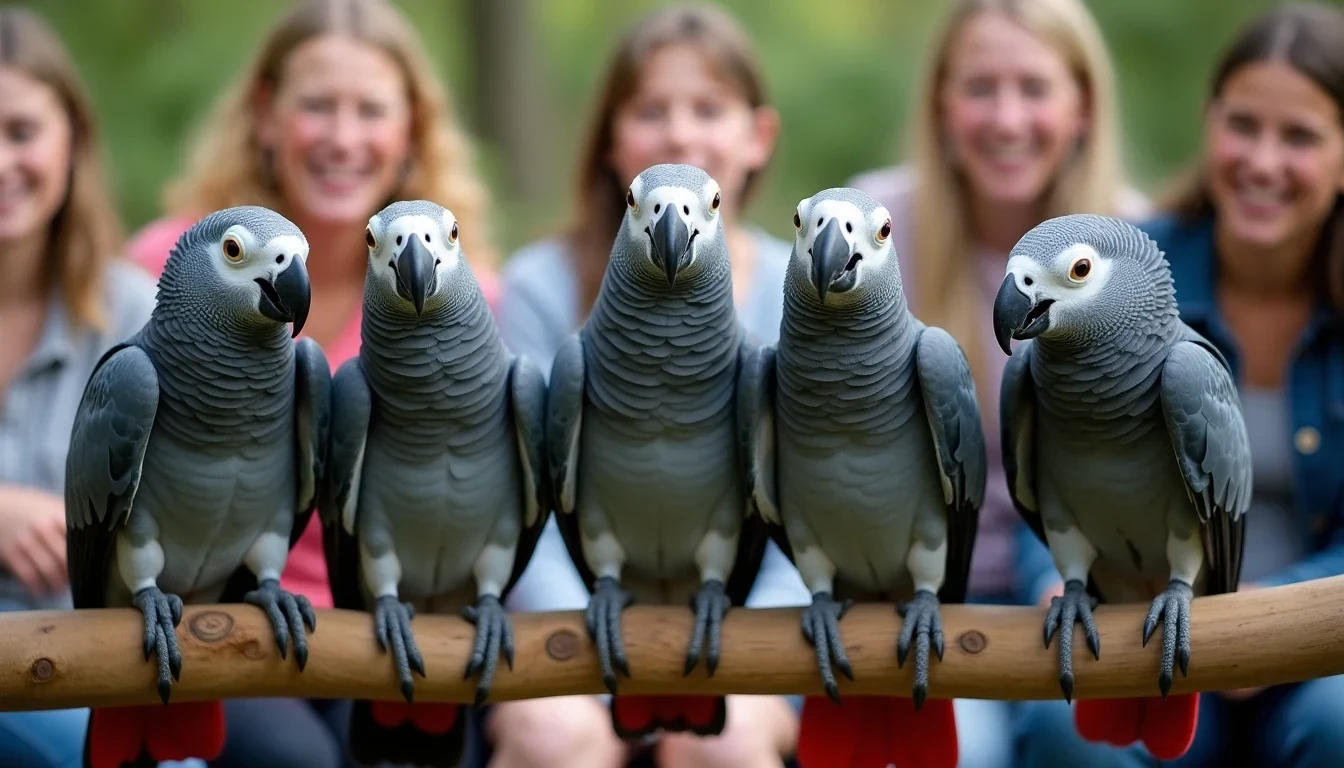
Five African grey parrots in a wildlife park in Lincolnshire turned profanity into group theatre. One bird would throw out the insult, the others would pile in, and then the whole enclosure would crack up with the human crowd. Billy, Eric, Tyson, Jade and Elsie picked up bad language and built a social routine around it, complete with timing, audience awareness, and a sense of who was supposed to laugh.
People miss this when they treat the story as a cute animal clip. The birds were not randomly noisy. They were reading the room, playing to it, and repeating whatever got a reaction. This is the same machinery that makes a rude joke travel faster than a polite one, or turns one person’s slang into a whole friend group’s vocabulary by Friday.
Five birds, one script
Steve Nichols, the chief executive at Lincolnshire Wildlife Park, said swearing in parrots was nothing new. The scale of it caught his attention. Five birds were encouraging one another, and once the first one started, the rest joined in with the same filthy enthusiasm.
The birds were quarantining together at the time, which gave them a tight social bubble and plenty of repetition. According to the BBC, the park split them into separate enclosures so the habit would not spread to the other 200 African greys on site. Nichols even joked that the park could end up with 250 swearing parrots if the behavior got loose.
This shows how fast a group habit can spread when the group is small, loud, and rewarded for performance.
Why the swearing worked
The visitor response mattered. People laughed, especially when the birds barked out a blunt “f*** off”, and the parrots seemed to clock that reaction immediately. Nichols said they appeared to know what they were doing. The birds were not simply copying sounds; they were linking a phrase to attention.
This is how mischief works in any social setting. A sharp remark gets a bigger laugh than a careful one. A rude aside breaks tension faster than a polite introduction. A person who knows how to provoke a reaction can control the temperature of a room, even if the reaction is disapproval.
The parrots understood the basic deal: say the thing, get the noise, enjoy the noise, repeat the thing.
What the birds were really teaching us
The easy reading is that the parrots learned swear words. The better reading is that they learned social leverage. They discovered that language can be used to command a room, and that a group can amplify that effect.
Humans do the same thing all the time, just with better manners and softer vocabulary.
A work team starts using the same shorthand because it signals belonging. A friendship group develops its own phrases, and outsiders hear the tone before they understand the words. A teenager picks up the cadence of the friends around them, then brings home the slang, the jokes, and the rhythm of conversation. In each case, the language is doing more than describing reality; it is marking who is inside the circle.
In South Africa, this is even more visible because speech shifts so easily across languages, accents, and social settings. People slide between English, Afrikaans, isiXhosa, isiZulu, Tsotsitaal, and local slang without making a ceremony of it. Someone says “howzit” in one room, “lekker” in another, and “just now” with a straight face in a third. This is social calibration.
Groups teach you how to sound
Birds and people both copy what gets rewarded. That can mean accent, humor, volume, body language, or whole ways of speaking.
The habits people absorb fastest
- The words used most often by the people closest to them
- The tone that gets approval, laughter, or eye-rolls
- The way a group signals status, warmth, or distance
- The jokes that are safe in one circle and disastrous in another
- The pauses, filler words, and vocal habits that quietly spread through a group
A person can feel polished in one setting and slightly off in another because the room changes the script. If you spend enough time around people who speak carelessly, you start sounding careless. If your circle values clean, direct speech, you usually sharpen up without noticing.
The parrots at Lincolnshire Wildlife Park show the same thing in louder form. One voice starts it, the others join in, and the group creates its own standard.
Provocation is social currency
The birds timed their insults for maximum effect because attention is a currency, and provocation spends well. This does not make it admirable; it makes it effective.
People do this with teasing, sarcasm, roasting, and playful rule-breaking. Done badly, it looks crude. Done well, it makes the speaker impossible to ignore. It can also be a test: who laughs? Who flinches? Who pretends not to hear? That is useful data in any social environment.
The parrots were not subtle, but they were socially competent. They learned that the fastest route to a reaction was not a pretty phrase. It was the one that made people gasp, then laugh.
You can choose the room that teaches you
The uncomfortable lesson in the bird story is that communication is contagious. You pick up what surrounds you. Your circle is not just company, it is training.
If you want to sound more composed, spend time around people who speak with precision. If you want to be read as calm, stop feeding on chaotic conversation. If your friends joke in a way that makes cruelty look clever, that tone will leak into your own mouth sooner or later.
A useful self-check is simple.
Ask yourself
- Which phrases do I repeat without thinking?
- Which people make me speak more carefully?
- Which rooms make me louder, sharper, or more defensive?
- Which habits in my speech help me, and which ones make me look cheap?
Billy, Eric, Tyson, Jade, and Elsie did not invent a language. They borrowed one that got a reaction and then reinforced it inside the group. People do the same with slang, posture, humor, and the whole performance of being socially alive. The only difference is that parrots say the rude part out loud.